




Fireside • Build It
Outdoor Fireplace Ideas: Designs, DIY Tips & Oven Combos
Looking for outdoor fireplace ideas? Here are 27 real backyard fireplaces from BrickWood customers, grouped into 9 designs, plus how a DIY outdoor fireplace goes together and what one costs.

The best outdoor fireplace ideas start with three choices: the material (classic red brick, natural stone or stone veneer, or stucco), the spot (an open patio, a covered patio, a corner or a long wall), and the extras (a raised hearth for seating, firewood storage and, for cooks, a pizza oven right beside the fire).
Every fireplace on this page is in a real backyard, and every one of them has a BrickWood pizza oven built next to it, above it or nearby. Each card links to the full photo gallery, so you can see how the footing, the block core, the firebox and the finish came together.
Outdoor Fireplace Ideas: Quick Answers
- Classic look: red brick over a block core, with a firebox lined in fire brick.
- Natural look: fieldstone or stone veneer, carried all the way up the chimney.
- Budget-friendly finish: stucco over block, with tile or timber accents.
- Rain or shine: build under a covered patio or pergola, with a chimney that clears the roof.
- Comfort: a raised hearth for seating and firewood bays in the base.
- For cooks: a pizza oven beside or above the fireplace.
- Cost: roughly $1,000 for a prefab kit up to $20,000 or more for a mason-built stone fireplace.
01Classic Red Brick Outdoor Fireplaces
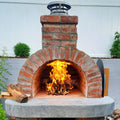
A red brick outdoor fireplace looks like it has always been there. Brick suits traditional homes, matches brick patios and walkways, and ages well. Many brick outdoor fireplaces are built around a concrete block core with the brick laid as the face, while the firebox itself is lined with fire brick that can take the heat.
Design tip: use a contrasting cap or mantel (bluestone, concrete or a timber beam) to break up a tall brick face.


02Natural Stone and Stone Veneer Fireplaces
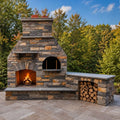
Stone is the most popular look for backyard fireplaces. Natural fieldstone feels rustic and heavy, while manufactured stone veneer gives the same look in a thinner, lighter, more even product that is easier for a DIYer to set. Both go over a block core, and both look best with a generous chimney that carries the stone all the way up.
Design tip: pick a stone color that ties to your house trim or patio pavers so the fireplace looks planned, not added.


03Stucco Outdoor Fireplaces
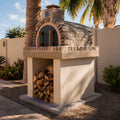
Stucco gives an outdoor fireplace a clean, Southwestern, Spanish or Mediterranean look and costs less than stone. It goes over a block structure, takes any color, and pairs well with tile accents, timber mantels and wrought iron. In wet or freezing climates, plan a cap that sheds water so the finish stays sound.
Design tip: set a tile medallion or a reclaimed wood mantel into the stucco for an easy focal point.


04Covered Patio and Pergola Fireplaces
A fireplace under a covered patio or pavilion gives you a place to sit by the fire in the rain. It is also the build that needs the most planning: the chimney has to run up through or past the roof with the right clearance, and anything that can burn needs to stay well back from the firebox and the flue. Talk to your building department before you design one, and keep open pergolas well above the fire.
Design tip: size the chimney so it clears the roofline. A tall chimney also draws better and keeps smoke out from under the roof.


05Corner, Wing-Wall and Long-Wall Layouts
Where the fireplace sits changes how the whole yard works. A corner placement saves space and frames a seating area. Wing walls that angle out from the firebox add counters, bench seats and wood storage. A long wall can hold a fireplace, an oven and storage in one run, and can double as a retaining wall on a sloped lot.
Design tip: face the opening toward where people will sit, and away from the prevailing wind, so smoke drifts away from your guests.


06Raised Hearths and Built-In Firewood Storage
The small details make an outdoor fireplace easy to live with. A raised hearth gives extra seating and puts the fire at a comfortable height. Firewood bays in the base keep wood dry and close at hand, and a counter beside the fireplace gives you a place to set down a drink or a plate.
Design tip: plan your firewood bays big enough to hold a few days of wood, and keep them under the counter so rain stays off.


07A Pizza Oven Beside or Above the Fireplace
This is where an outdoor fireplace becomes an outdoor kitchen. Owners build the pizza oven right beside the fireplace as one masonry feature, or stack the oven above the firebox to save patio width. Either way, each fire needs its own properly designed flue, and the structure has to carry the weight. Many of these homeowners built an outdoor fireplace with a pizza oven using our Mattone Barile and Mattone Barile Grande kits. See more pizza oven and fireplace combos and ovens built above a fireplace.


08Fireplaces in an Outdoor Kitchen
Pair the fireplace with counters, a grill, a sink or a pizza oven and the backyard becomes a full outdoor room. Keep the cooking zone and the sitting zone close enough to talk across, but separate enough that the cook has room to work.
Design tip: run gas, water and power lines before the masonry goes up, and have licensed pros do that work.


09A Patio Built Around the Fire
Some of the best backyard fireplace ideas are really patio ideas. A round or curved patio facing the fire, a ring of chairs, a seat wall and good lighting turn a fireplace into the place everyone gathers after dinner.
Design tip: leave a clear walkway between the hearth and the chairs so no one has to step over the hearth to get by.


Not ready for a full fireplace? The Fire Pit Grill Kit turns a simple block fire pit into a wood-fired grill for a fraction of the cost, and it can come later as a second fire feature.
Can You Build a DIY Outdoor Fireplace?
Yes. A DIY outdoor fireplace is a big but doable weekend-by-weekend project for a handy homeowner: a reinforced concrete footing, a concrete block core, a firebox lined with fire brick, a smoke chamber and chimney, and a stone, brick or stucco finish. Get your permit first and follow your local code.
Every build is different, but most masonry outdoor fireplaces come together in the same order:
- Check the rules. Ask your building department about permits, setbacks from the house, property lines, fences and trees, and any burn restrictions in your area before you dig.
- Pour the footing. A masonry fireplace is very heavy. It needs a reinforced concrete footing sized for the load, poured below the frost line where your code requires it.
- Build the block core. Concrete block forms the base, the firebox walls and the chimney. Fill and reinforce the cores as your plans call for.
- Line the firebox with fire brick. The fire never touches regular brick or block. Line the firebox with fire brick set in refractory mortar, which are made to take direct flame. Our guide explains why regular brick doesn't belong in the fire.
- Shape the smoke chamber and flue. A shallow firebox with angled side walls throws more heat out to you. Above it, the smoke chamber narrows into the flue. A common rule of thumb is a flue opening about one-tenth the area of the fireplace opening. Too small a flue is the usual cause of a smoky fireplace.
- Run the chimney tall enough. A taller chimney draws better. Near a roof, building codes set how far the chimney has to rise above the roofline and above anything nearby, so check the rule for your area.
- Add the hearth and finish. Extend a noncombustible hearth in front of the opening (many codes call for roughly 16 to 20 inches), then apply your stone veneer, brick or stucco and set a cap that sheds water.
- Start with small fires. Let the mortar cure, then build a few small fires before a big one, the same slow-start idea as curing a pizza oven.
How Much Does an Outdoor Fireplace Cost?
An outdoor fireplace can cost anywhere from about $1,000 for a simple prefab kit you assemble yourself to $20,000 or more for a large stone fireplace built by a mason. A DIY masonry fireplace usually lands in between, and the finish, the chimney height and local labor rates move the number most.
| Type of build | Rough cost | What drives it |
|---|---|---|
| Prefab fireplace kit | About $1,000 to $5,000 | Size, steel or block kit, finish you add on top |
| DIY masonry fireplace | About $2,500 to $8,000 in materials | Footing size, block and fire brick, veneer choice, chimney height |
| Mason-built fireplace | About $5,000 to $20,000 and up | Labor, natural stone, tall chimneys, covered-patio work |
These are rough national ranges for planning, not quotes. Price your materials and labor locally before you commit. Stucco usually costs less than stone, manufactured veneer less than natural fieldstone, and a chimney that has to clear a roof costs more than a short freestanding one.
Where to Put an Outdoor Fireplace
- Check setbacks first. Your town decides how close a fireplace can be to the house, property lines, fences and trees.
- Watch the wind. Face the opening away from the prevailing wind so smoke drifts away from the seating area and your windows.
- Look up. Keep the fire and the top of the chimney well clear of branches, eaves and pergola beams.
- Plan the view. A fireplace becomes the focal point of the yard. Place it where you'll see it from the patio and from inside the house.
- Think about the next project. If a pizza oven, grill or counters might come later, leave room on the footing and patio now.
Frequently Asked Questions
What is the best material for an outdoor fireplace?
Brick, natural stone, stone veneer and stucco all work well as the outside finish, usually over a concrete block core. Whatever the finish, the firebox should be lined with fire brick set in refractory mortar, because regular brick and block are not made for direct flame.
Can you build an outdoor fireplace yourself?
Yes. Many homeowners build their own with a reinforced concrete footing, a block core, a fire brick firebox, a chimney and a stone, brick or stucco finish. It is a big project, so get a permit first and follow your local building code.
How much does an outdoor fireplace cost?
Roughly $1,000 to $5,000 for a prefab kit, about $2,500 to $8,000 in materials for a DIY masonry fireplace, and about $5,000 to $20,000 or more for a mason-built fireplace. Stone, tall chimneys and covered-patio work cost the most.
Can you put an outdoor fireplace under a covered patio?
Yes, with careful planning. The chimney has to run up through or past the roof with the clearances your code requires, and anything that can burn has to stay well away from the firebox and flue. Check with your building department before you design it.
How far should an outdoor fireplace be from the house?
There is no single number. It depends on your local code, whether the fireplace has a chimney, and what your walls and roof are made of. Ask your building department about setbacks before you pour the footing.
Can you add a pizza oven to an outdoor fireplace?
Yes. Owners build the oven right beside the fireplace as one masonry feature, or stack the oven above the firebox. Each fire needs its own properly designed flue, and the base has to be built to carry both.
Do you need a permit for an outdoor fireplace?
Often, yes. A masonry fireplace with a footing and a chimney usually needs a permit, and many areas also have burn rules and burn bans. Check with your city or county before you start.

100% FREE
Building a Fireplace? Add a Brick Oven Beside It
Every fireplace on this page was built with a BrickWood oven alongside it. Our free plans show you how to build the oven and its base, with a complete materials list for every BrickWood oven, so you can price the whole build locally before you buy a thing.
- Plans for every BrickWood oven and its base
- Complete materials and tools lists
- Emailed to you as PDFs, ready to print
Already signed up and don't see them? Check your Spam or Promotions folder.
Not sure which oven fits your backyard? Compare Oven Kits →
Keep Reading
IdeasPizza Oven Ideas: 13 Backyard Builds by HomeownersChimneyPizza Oven Chimney Guide: Dampers, Draft and Smoke ExplainedBrickCan You Use Regular Brick for a Pizza Oven or Fire Pit?FirewoodFirewood for Pizza Ovens: Best Wood to Burn and What to Avoid
Costs are rough planning ranges and vary by region, materials and labor. Fireplace and chimney rules vary by city and county. Always check permits, setbacks, clearances and burn rules with your local building department before you build.


